What Are Demonstratives?
Demonstratives in Spanish are words we use to point to or make reference to the position of something or someone in relation to the speaker and the listener. Their correct use is essential for clear and precise communication, as they help us identify and distinguish objects, people, or ideas in space and time.
Definition of Demonstratives
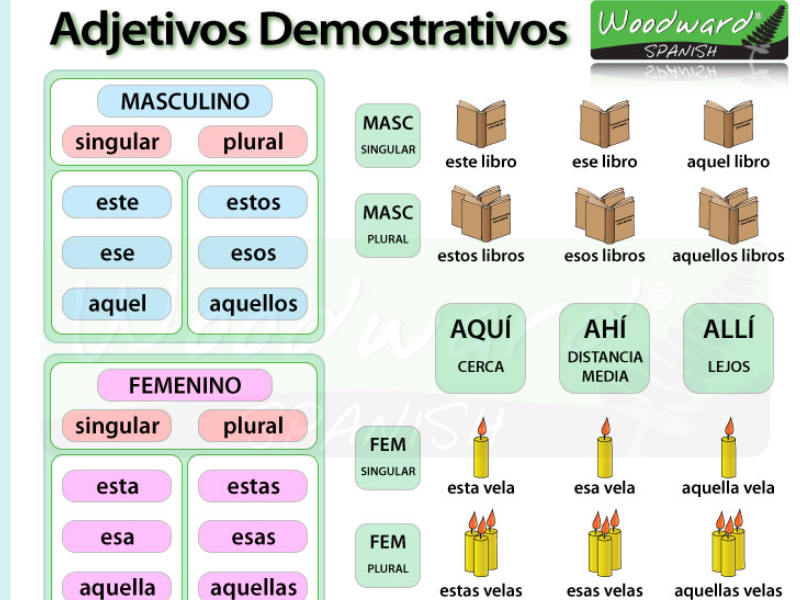
Demonstratives are terms that indicate the location of a noun in relation to space or time, from the speaker’s perspective. In Spanish, demonstratives vary according to the gender (masculine or feminine) and number (singular or plural) of the noun they refer to, and are classified into three degrees of proximity: nearness, middle distance, and distance.
Classification and Examples
1. Demonstratives of Nearness
Indicate that the object or person is close to the speaker.
-
Este (masculine singular): “Este libro es interesante.” (This book is interesting.)
-
Esta (feminine singular): “Esta mesa está limpia.” (This table is clean.)
-
Estos (masculine plural): “Estos zapatos son nuevos.” (These shoes are new.)
-
Estas (feminine plural): “Estas llaves son mías.” (These keys are mine.)
2. Demonstratives of Middle Distance
Indicate that the object or person is at a middle distance, neither very close nor very far, possibly near the listener.
-
Ese (masculine singular): “Ese coche es rápido.” (That car is fast.)
-
Esa (feminine singular): “Esa casa es grande.” (That house is big.)
-
Esos (masculine plural): “Esos árboles son altos.” (Those trees are tall.)
-
Esas (feminine plural): “Esas flores son hermosas.” (Those flowers are beautiful.)
3. Demonstratives of Distance
Refer to objects or people that are far from both the speaker and the listener.
-
Aquel (masculine singular): “Aquel monte es peligroso.” (That mountain over there is dangerous.)
-
Aquella (feminine singular): “Aquella estrella brilla mucho.” (That star over there shines brightly.)
-
Aquellos (masculine plural): “Aquellos días fueron los mejores.” (Those days were the best.)
-
Aquellas (feminine plural): “Aquellas noches eran frías.” (Those nights were cold.)
Importance in Education
Mastering demonstratives is crucial for Spanish learners because:
-
Improves communicative precision: Allows clear specification of the location of objects or people in relation to the speakers.
-
Enriches written and oral expression: Adds important nuances when describing scenes, narrating stories, or giving instructions.
-
Facilitates reading comprehension: Helps understand spatial and temporal context in various texts.
Additional Information
Beyond the basic aspects already covered, there is more useful information about demonstratives that can enrich your understanding and use of these in the Spanish language.
Neuter Forms of Demonstratives
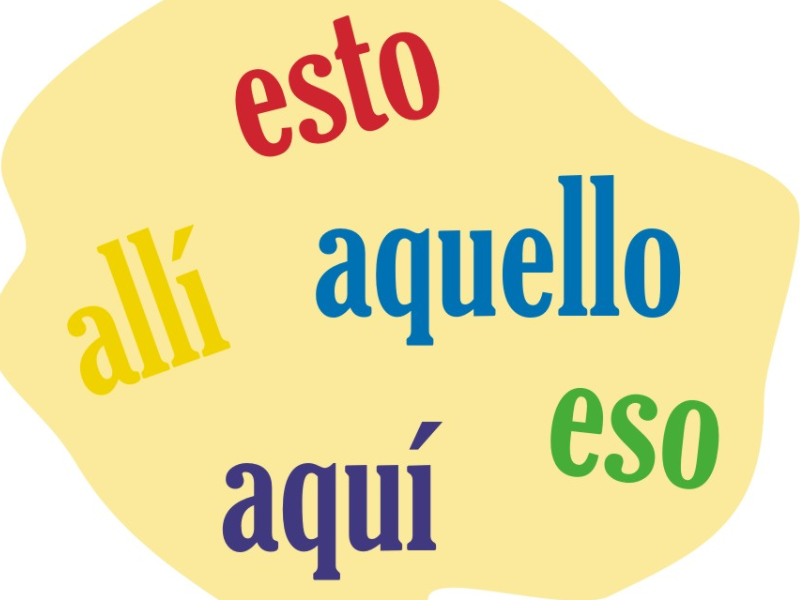
Spanish also has neuter forms of demonstratives, used to refer to ideas, situations, or undefined objects. These forms do not vary in gender or number and are:
-
Esto: for near references. Example: “¿Qué es esto? No lo entiendo.” (What is this? I don’t understand it.)
-
Eso: for middle distance references. Example: “Eso me parece extraño.” (That seems strange to me.)
-
Aquello: for distant references. Example: “Aquello fue increíble.” (That was incredible.)
These neuter forms are especially useful in abstract conversations or when the noun being referred to is not specific or known.
Demonstratives vs. Definite Articles
It is important not to confuse demonstratives with definite articles (el, la, los, las), although both precede a noun. The key difference is that demonstratives add a layer of information about the location or relative distance of the referred noun, while definite articles do not.
Using Demonstratives in Questions
Demonstratives are often used in questions to specify which object or person we are inquiring about, especially in contexts where distance is relevant:
-
“¿Qué opinas de ese libro?” (What do you think of that book?) — the book is near the listener
-
“¿Puedes pasarme esos documentos?” (Can you pass me those documents?) — the documents are at a middle distance
-
“¿Recuerdas aquella vez en la playa?” (Do you remember that time at the beach?) — reference to a situation distant in time or space
Note on Accent Marks
Historically, demonstratives carried an accent mark (tilde) when functioning as pronouns to differentiate them from when they acted as adjectives. However, the Royal Spanish Academy (RAE) currently maintains that context is usually sufficient to avoid confusion, so the use of the accent is no longer normative. Despite this, it is common to find older texts or people who still use the accent out of habit or for clarity.
Demonstratives in Colloquial Language
In everyday speech, it is common to use demonstratives to express emotions or emphasize opinions, sometimes extending their use beyond strict rules of physical proximity:
-
“¡Este frío es insoportable!” (This cold is unbearable!) — although cold has no location, “este” is used to express an immediate personal experience
-
“¿Viste esa película? Es increíble.” (Did you see that movie? It’s incredible.) — using “esa” to refer to something not physically present but part of the conversation
Conclusion
Through the pedagogical approach of iNMSOL, students can master their use and application, significantly improving their communicative skills in Spanish. Constant practice and exposure to real-life situations are key to internalizing these terms and using them with confidence in any context.