Register at iNMSOL!

Create your personal account in our website and:

  • View your orders
  • Manage and edit your account
  • Get exclusive advantages

Creating an account is very easy:

  1. Click on “create my account” below
  2. Indicate your username and email
  3. Set a password
  4. Done! You are now a member of iNMSOL community, welcome!

Follow Us

Mistakes made by native English speakers while learning Spanish

Common Mistakes English Speakers Make When Learning Spanish

Learning a new language is an adventure. It brings challenges, discoveries and a few stambles. For English speakers, Spanish is charming but can it is also challenging. The rhythms, sounds and  structures are new. From iNMSOL we show you the main difficulties. Let’s decode together the common mistakes English speakers make in Spanish. 

learning spanish

Beware of False Friends!

English and Spanish shares lots of similar words sinche they both have Latin roots. But don’t be fooled! False friends are always lurking.
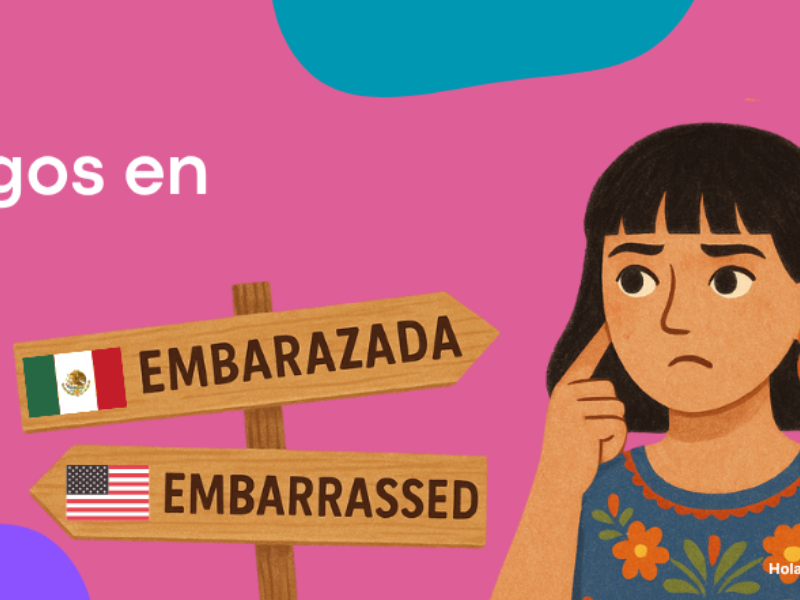
  • Embarazada does not mean “embarrassed”. It means “pregnant”.
  • Ropa  is not “rope”. It’s “clothes”.
  • Asistir does not always mean “assist”. In many contexts, it means “attend”.

false friends

Reflexive Verbs: A Real Headache

For English speakers, this concept is tricky at first.
  • In English, we say “I wake up.” In Spanish, it is “Me despierto.”
  • It is not “I shower.” It is “Me ducho.”
The trick? Remember that the verb reflects the action back to the subject.

The Mystery of Gender in Nouns

In English, objects have no gender. In Spanish, it is essential. You must know if something is masculine or feminine.
  • It is “el libro” (the book). Not “la libro.”
  • It is “la mesa” (the table). Not “el mesa.”
A good trick? Look at the endings. Words ending in -o are usually masculine. Those ending in -a are feminine.

Prepositions: ¿Por or Para?

Both can translate as “for” in English. But they have very different uses.
  • We use por for causes, reasons, and periods of time.
  • Para indicates purpose, direction, or deadlines.
Example: “Estudio por la mañana” (I study in the morning). But “Estudio para el examen” (I study for the exam).
learning spanish

Stumbling Over the Subjunctive

The subjunctive mood in Spanish is a complex beast. It has no direct equivalent in English.
  • We do not say “I hope she is here.” We say “Espero que esté aquí.”
The solution? Practice and exposure to real situations. Only then will you master this aspect.

Frequently Asked Questions

  • Why is gender so important in Spanish? Gender does not only affect the noun. It also influences adjectives and articles. It is crucial for agreement in the sentence.
  • Are there more “false friends” in Spanish? Of course! There are many more. It is essential to stay alert. Don’t fall into the trap.
  • How can I improve my use of the subjunctive? Expose yourself to real conversations. Read in Spanish. Practice with specific exercises. These are effective ways.

Conclusion

Diving into Spanish as an English speaker is a linguistic rollercoaster. There are challenges. There are common mistakes English speakers make in Spanish to avoid. But there is also incredible richness. Every mistake is a step toward mastery. Cheer up! Keep practicing.
Want to dig deeper? Discover our Spanish courses for English speakers at iNMSOL.
0
    0
    Your purchase
    You haven't added anything...Back to catalogue
    Test your skills image

    What's your Spanish level?

    Take our free online level test and discover where you stand. It only takes a few minutes!
    Skip to content